24 month contract
No upfront cost
Unlimited
5G data
£15.00
a month
was £19.00
24 month contract
No upfront cost
Unlimited
5G data
£16.00
a month
was £19.00

24 month contract
No upfront cost
Unlimited
5G data
£15.00
a month

24 month contract
£15.00 upfront
Unlimited
5G data
£21.00
a month
12 month contract
No upfront cost
Unlimited
5G data
£24.00
a month
12 month contract
No upfront cost
Unlimited
5G data
£24.00
a month
12 month contract
No upfront cost
Unlimited
5G data
£24.00
a month
24 month contract
£15.00 upfront
Unlimited
5G data
£25.00
a month
1 month contract
No upfront cost
Unlimited
5G data
£28.00
a month
1 month contract
No upfront cost
Unlimited
5G data
£28.00
a month
24 month contract
£45.00 upfront
200GB
5G data
£35.00
a month
1 month contract
£150.00 upfront
MB
5G data
£40.00
a month

Colour:
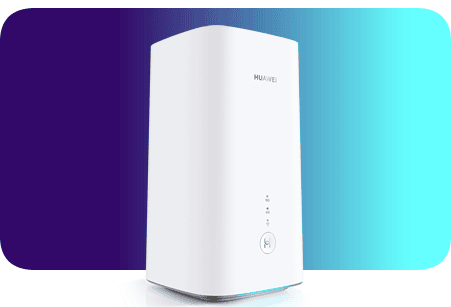
5G and 4G Broadband uses a router to connect to mobile networks and then share this internet with your household over Wi-Fi.
Modern networks can deliver speeds that rival fibre-broadband with the added advantages of not needing a landline, being able to be used anywhere with a mains-connection and the flexibility of shorter contracts.
5G and 4G Broadband works very much the same way as fibre broadband, but they key difference is that they connect over-the-air to a mobile network as opposed to a physical network cable.
The router then shares this internet over a private Wi-Fi network, so you can connect all your devices to the internet. They come with a SIM-card enabling them to connect to the mobile network.
Some of the benefits include not needing a landline, shorter contract lengths and being able to use them anywhere with a mains-socket. Modern 5G networks also deliver speeds are often faster than the available fibre broadband in many areas.
5G and 4G Broadband are available in the UK on EE, National Broadband, Three and Vodafone.
We’d always recommend choosing a 5G Broadband router if coverage is available in your area as speeds are far superior.
|
Device |
Wi-Fi Version |
Maximum Speeds |
|---|---|---|
|
EE Smart 5G Hub |
Wi-Fi 7 |
Up to 3.8Gbps |
|
EE Smart 4G Hub |
Wi-Fi 5 |
Up to 600Mbps |
|
National Broadband 4G Router |
Wi-Fi 6 |
Up to 3.8Gbps |
|
National Broadband 5G Router |
Wi-Fi 5 |
Up to 600Mbps |
|
Three 4G Hub |
Wi-Fi 5 |
Up to 600Mbps |
|
Three 5G Hub |
Wi-Fi 6 |
Up to 3.8Gbps |
|
Vodafone Gigacube |
Wi-Fi 6 |
Up to 3.8Gbps |
Those looking for maximum performance should also favour higher Wi-Fi versions, which deliver improve coverage, faster speeds and additional functionality.
5G Broadband can be expected to deliver average speeds of around 150Mbps, but performance varies based on coverage and network congestion. That’s more than enough for the average household, although heavy data users might still want to consider fibre broadband which can go beyond 1Gbps.
|
Network |
Average 5G Download Speed (Mbps) |
Average 5G Upload speed (Mbps) |
|---|---|---|
|
EE |
92.2 |
16.0 |
|
O2 |
89.9 |
11.0 |
|
Three |
187.0 |
20.2 |
|
Vodafone |
130.9 |
14.1 |
4G Broadband can be expected to deliver speeds around 30Mbps, which is great for browsing, but not ideal for streaming 4K video as it is close to the minimum recommend speeds. You also need to remember that if using for the whole household the speed will be shared between devices using the connection.
The first and easiest thing to try is adjusting the position of your router. Placing it close to a window and as high up as possible is a good starting point, but we’d recommend trying a few different locations to see what works best for you.
If that doesn’t work, there is always the option of purchasing an external antenna. This connects to the router and then is attached outside your property to boost signal. National broadband sell versions of their router that come with an external antenna installation, so this is worth considering if performance is proving to be a problem.
5G and 4G Broadband is great, but for the very fastest speeds you still want to be looking at fibre-broadband. However, for many users 5G will deliver more than enough speed and in many areas the fibre available performs worse than 5G Broadband.
Additionally, gamers looking for the best experience should also consider fibre broadband for the very lowest pings. However, we’re talking about only the most serious gamers as 5G delivers latency around 35ms, while fibre averages around 20ms.